
Free consultation request line · Albuquerque Metro
Albuquerque Xeriscape Installation, Turf Removal & Low-Water Landscaping
Request a free xeriscape consultation for Albuquerque xeriscape design, xeriscaping installation, lawn and turf removal, sprinkler-to-drip conversion, native and drought-tolerant planting, rock and gravel hardscape, and ABCWUA rebate guidance for eligible Water Authority customers.
Consultation request line · Albuquerque Metro · ABCWUA rebate guidance for eligible Water Authority customers
Albuquerque Xeriscape is an independent consultation-request website. Work is performed by an independent local New Mexico designer or installer when available. Provider identity, scope, written pricing, schedule, license/insurance documentation, and rebate eligibility are confirmed before work begins.
Albuquerque xeriscape consultation requests
- Albuquerque xeriscape and xeriscaping design
- Lawn removal, grass removal, turf removal, and lawn replacement
- Lawn-to-xeriscape and turf-to-xeriscape conversion
- Sprinkler-to-drip irrigation conversion
- Native and drought-tolerant planting
- Rock, gravel, decomposed granite, boulders, mulch, and dry creek beds
- ABCWUA xeriscape rebate guidance for eligible Water Authority customers
- HOA common-area xeriscape conversion
- Commercial low-water landscaping and turf reduction
What this consultation request line does not cover
- Lawn mowing and ongoing maintenance contracts
- New sod installation
- Emergency irrigation repair
- Tree removal or stump grinding
- General yard cleanup or seasonal maintenance-only work
- Fence, deck, or pergola construction
- Pool, pond, or fountain installation
- Pest control or weed-treatment-only services
Not sure if it is called xeriscape?
Homeowners describe this work many ways: xeriscaping, low-water landscaping, drought-tolerant landscaping, desert landscaping, rock landscaping, gravel landscaping, lawn removal, grass removal, lawn replacement, front yard conversion, backyard grass removal, or replacing grass with native plants and gravel. This consultation request line focuses on those same projects — xeriscape installation, lawn and turf removal, low-water and drought-tolerant landscaping, front yard xeriscape, backyard xeriscape, rock and gravel landscaping, sprinkler-to-drip conversion, and xeriscape cost guidance.
Rio Rancho? Rio Rancho xeriscape uses the City of Rio Rancho Outdoor Rebates program — separate pre-approval rules apply and it is not part of the ABCWUA rebate.
Albuquerque xeriscape, installation, and low-water landscaping services
Water-wise and xeriscape landscape design tuned to high-desert sun, wind, freeze, and Southwest architecture. Drought-tolerant plants, drip zones, gravel, boulders, and dry creek beds.
Learn more →Lawn removal, grass removal, sod removal, and turf-to-xeriscape conversion. Drip conversion, mulch, and planting included. ABCWUA application, initial inspection, and approval required before any removal for rebate projects.
Learn more →Convert spray sprinklers to drip irrigation, bubblers, or hand-watering for xeriscape projects. Sprinkler-to-drip conversion is required for ABCWUA rebate projects; pressure-compensating emitters and hydrozones for native and drought-tolerant plantings.
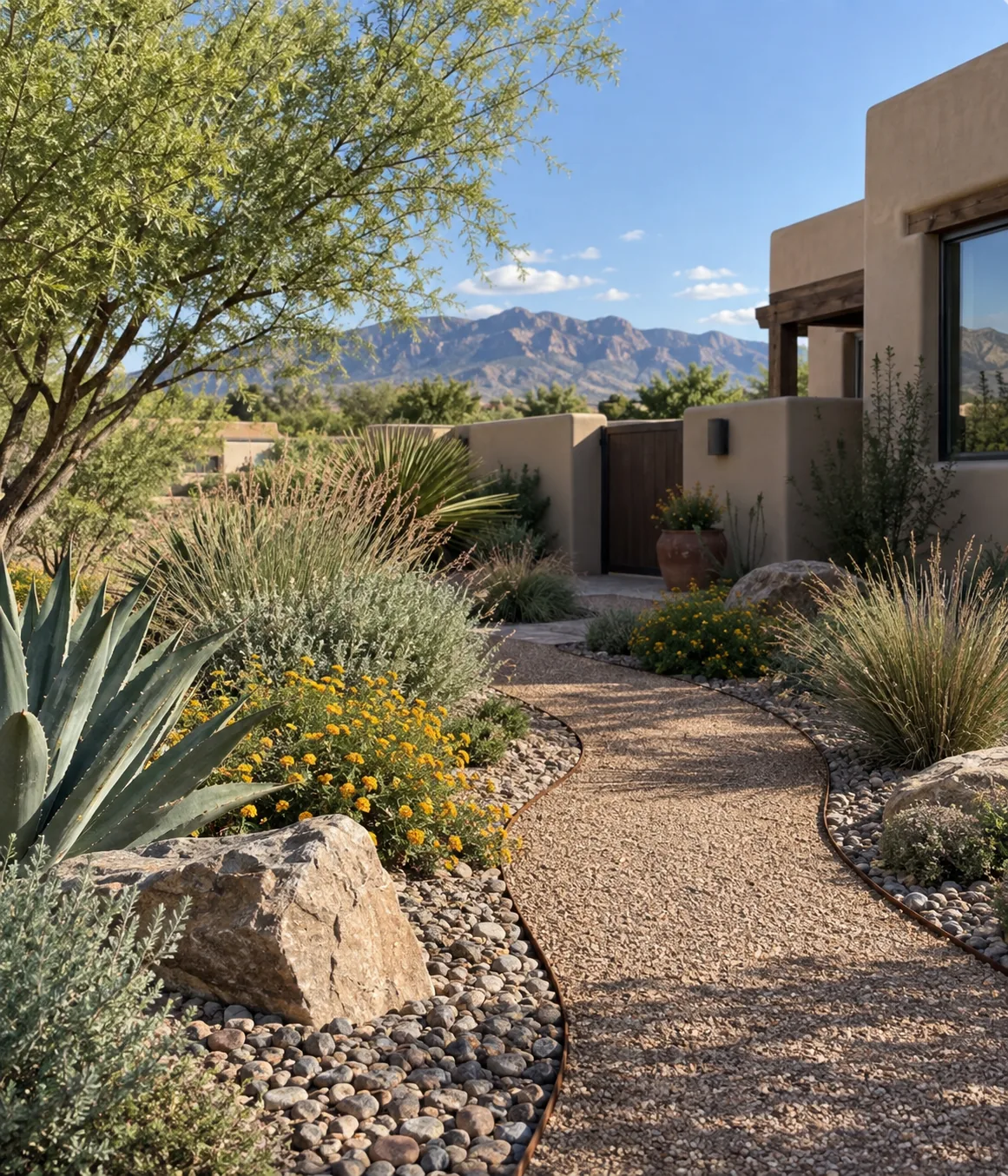
Learn more →Drought-tolerant and native plant palettes for Albuquerque xeriscape: chamisa, apache plume, agave, yucca, Russian sage, salvia, desert willow, and more. Cold-hardy species tuned to the high desert at ~5,300 ft.
Learn more →Rock landscaping, gravel landscaping, decomposed granite paths, dry creek beds, boulder placement, flagstone, and decorative rock — designed with shade, drainage, and heat management as part of a balanced xeriscape.
Learn more →Help preparing rebate-ready conversions for the ABCWUA xeriscape rebate — also called a turf removal rebate or lawn removal rebate. Application, plant allowance, drip conversion, mulch coverage, and final documentation prep.
Learn more →Common-area lawn replacement, turf removal, entry monuments, medians, and pocket lawns for Albuquerque-area HOAs and master-planned communities. Low-water landscaping and HOA board packet support where the matched provider offers it.
Learn more →Commercial low-water landscaping and turf conversion for Albuquerque office parks, retail centers, multifamily properties, and institutional landscapes. Water-bill reduction, curb appeal, and rebate-ready planning. Phased installation supported.
Learn more →Albuquerque metro & surrounding communities
Service availability, water provider, and rebate eligibility are confirmed by address. Rio Rancho is not part of the ABCWUA xeriscape rebate program — the City of Rio Rancho runs its own Outdoor Rebates program with separate pre-approval rules.
See full service area →- Albuquerque (citywide)
- Northeast Heights
- Far Northeast Heights
- North Valley
- South Valley
- Foothills / Sandia Heights
- Tanoan
- Westside / Ventana Ranch
- Paradise Hills
- Rio Rancho
- Corrales
- Bernalillo
- Placitas
- Los Lunas
- Belen
- Tijeras
- Edgewood
How a consultation request becomes an installed xeriscape
- STEP 01Submit a consultation request
Call or submit the form. We collect property type, address, water provider, approximate turf square footage, current irrigation, project notes, and timeline. Requests are reviewed during business hours.
- STEP 02Routing & provider availability
If the request fits the service area, scope, and current provider availability, it is routed to an independent local New Mexico xeriscape designer or installer. If no provider is available, you are told so.
- STEP 03On-site assessment
The matched provider visits the property, measures the conversion area, photographs existing conditions, and discusses design preferences, water budget, hardscape, and any HOA standards.
- STEP 04Written proposal & rebate application prep
You receive a written design proposal, planting plan, irrigation design, and itemized pricing. For ABCWUA rebate projects, the matched provider can help prepare the plan and documentation; the property owner or authorized account contact submits the ABCWUA online application and schedules the initial inspection before any turf is removed.
- STEP 05Installation
Turf removal, soil prep, drip irrigation, planting, hardscape, and rock work. Most residential projects complete in roughly 1–3 weeks depending on scope, weather, and plant availability.
- STEP 06Post-conversion documentation
For ABCWUA rebate projects, the provider helps prepare post-conversion documentation including itemized zero-balance receipts. ABCWUA conducts the final inspection and processes the rebate. Final eligibility, amount, and payment timing are controlled by ABCWUA.
What you can expect from this consultation request line
There is no cost to submit a request. Submitted requests are reviewed during business hours and routed when a local provider is available and the project fits. Any design fee, site-visit fee, proposal fee, or installation cost must be confirmed directly with the matched provider before work begins.
Matched providers should be familiar with the ABCWUA xeriscape rebate process, including application preparation, plant allowance planning, irrigation conversion requirements, initial inspection timing, and final documentation. ABCWUA controls approval and payment.
Plant selection is matched to the Albuquerque high-desert climate at roughly 5,300 feet — cold-hardy natives, monsoon-aware drip irrigation, and freeze-tolerant species, not generic 'desert landscaping'.
Requests are routed only when a provider is available and the project fits their service area, scope, and timeline. If no provider is available or the project does not fit the current routing criteria, the request may not be routed.
All design and installation pricing is confirmed in writing by the matched provider after on-site assessment. No work begins without an itemized proposal you have approved.
Customers should verify any claimed license, registration, contractor classification, insurance, and workers compensation documentation directly with the matched provider before signing.
Homeowners, HOAs, commercial property owners, and managers
Single-family homeowners converting front yards, back yards, or full properties. ABCWUA-eligible addresses can request rebate-ready planning.
Albuquerque-area HOAs converting common-area turf, entry monuments, medians, and pocket lawns. Board packet support where the matched provider offers it.
Office parks, retail centers, medical and professional buildings converting underused turf for water savings and curb appeal.
Apartment, condominium, and multifamily landscapes reducing irrigation demand and ongoing maintenance.
Property-management firms coordinating xeriscape conversions across multiple properties on behalf of owners.
Schools, nonprofits, and public-facing properties converting non-functional turf where the matched provider meets vendor, insurance, access, and procurement requirements.
Quick answers about ABCWUA, providers, and how the site works
Are you ABCWUA?
Is it xeriscape, xeroscape, or zeroscape?
Do I need pre-approval before removing turf for the ABCWUA rebate?
Does Rio Rancho qualify for the ABCWUA rebate?
Who actually does the work?
How much water can a xeriscape conversion save?
What information should I have ready?
Are calls and forms tracked?
Water savings research
How much water does xeriscape actually save?
Eleven area-normalized estimates — 11.2 to 76.0 gallons per sq ft per year — with methods, denominators, and an audit of Albuquerque’s published figures.
Ready to request a free Albuquerque xeriscape consultation?
Submit the form or call. The request is reviewed during business hours and routed to a local provider when one is available and the project fits. There is no service guarantee, response-time guarantee, or rebate guarantee — ABCWUA controls all rebate decisions.
Do not remove turf before ABCWUA application, initial inspection, and approval. Verify current rebate amount, plant allowance, mulch, and receipt requirements at abcwua.org. Rio Rancho addresses follow the City of Rio Rancho Outdoor Rebates program — not ABCWUA.